
The clinical judgment model is a critical part of the NCLEX exam. Since the introduction of Next Generation NCLEX (NGN) in April 2023, it has become a key focus of the NCLEX-RN exam. The purpose of the NCLEX is to check the readiness of nursing graduates to provide safe and effective client care. For this purpose, the exam now highlights the ability of nurses to analyze client information, identify key clinical signs, and make the right decisions in real-life situations (NCSBN, 2023).
What is the Importance of the Clinical Judgment Model in the NCLEX-RN Exam?
Clinical judgment is an essential skill for nurses. The exam now tests the test taker’s ability to think critically and prioritize client care rather than just recalling facts. This change reflects real-life nursing, where nurses must quickly and accurately decide to ensure positive client outcomes (Sharmila, 2022). Below are the key points that show why the clinical judgment model is significant in the NCLEX-RN exam:
1. Ensuring Client Safety and Quality of Care
In hospitals or healthcare settings, nurses are the first to notice small changes in a client’s condition. If they fail to spot early warning signs, it can lead to severe complications or even death (Joint Commission, 2024). For example, if a client recently had surgery, suddenly becomes confused, breathes faster, and has low oxygen levels. The nurse needs to quickly recognize these signs as possible symptoms of a pulmonary embolism and act immediately. Without strong clinical judgment skills, the nurse might miss these signals, resulting in a delay in diagnosis and treatment.
2. Bridging the Gap between Nursing Knowledge and Nursing Practice
A big challenge in nursing education is moving from textbook knowledge to real-world practice. Many students can remember nursing facts but have trouble applying them in unexpected clinical situations (Ajani & Moez, 2011). The NCLEX RN exam assesses nurses’ capability to apply their knowledge through clinical judgment, critical thinking and decision making to provide safe client care.
3. Utilizing the NCSBN Clinical Judgment Measurement Model (CJMM)
The National Council of State Boards of Nursing (NCSBN) introduced the Clinical Judgment Measurement Model (CJMM). It measures the nursing practice for client care. This model outlines six systemic steps:
- Recognizing Cues: Noticing key client information like vital signs, lab results, and symptoms.
- Analyzing Cues: Understanding what this information indicates for the client’s health.
- Prioritizing Hypotheses: Deciding which problems are most urgent and likely to affect the client.
- Generating Solutions: Thinking about possible nursing actions to take.
- Taking Action: Applying the best nursing interventions to meet the client’s needs.
- Evaluating Outcomes: Reviewing that actions were successful or not. If not, considering what changes could improve the outcome.
An easy way to remember these steps is by using the acronym RAG-PET. You can picture a dog playing with a rag. It helps you recall the steps.
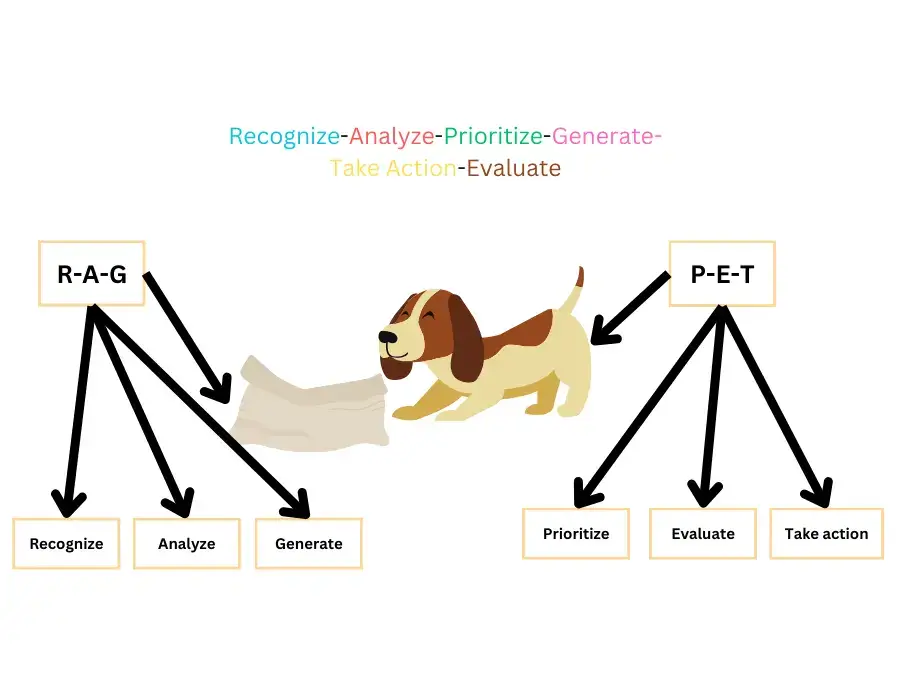
The CJMM ensures that nurses make decisions systemically, lowering the chances of errors in client care (NCLEX, 2024).
4. Assessing Real-World Decision-Making through NGN Question Types
The Next Generation NCLEX (NGN) uses new question formats to evaluate a nurse’s clinical judgment. It includes case-based scenarios where the nurse assesses client information and makes decisions like those in real-life situations. The exam also has matrix/grid questions, drop-down menus, drag-and-drop sequencing, and bow-tie questions.
These formats require nurses to use higher-level thinking and decision-making skills. It ensures that nursing graduates possess knowledge and can make clinical decisions in fast-paced and high-pressure situations (Camp-Spivey, Crawford & Bratnichenko, 2024).
5. Improving Critical Thinking and Adaptability
Clinical judgment is essential because every client is unique. Nurses need to think critically and adjust to different situations. For example, two clients may appear with similar symptoms but require different treatments based on their medical history, allergies, or other health issues. A solid understanding of the clinical judgment model helps nurses evaluate each client and customize their care accordingly (Hodges, 2010).
6. Reducing Medical Errors and Enhancing Client Outcomes
Medical errors are a leading cause of harm to clients in healthcare. Nurses lacking good clinical judgment may administer the wrong medication, delay treatments, or fail to recognize serious health problems (Samia et al, 2024). By focusing on the clinical judgment model in the NCLEX RN exam, the test ensures that only candidates who can think critically, spot potential errors, and make informed decisions are allowed to practice. This focus leads to better client outcomes, fewer complications, and improved quality of client care.
7. Enhancing Professional Confidence and Readiness
A nurse’s ability to make quick and effective decisions affects their confidence in practice. Nurses who develop strong judgment skills are more confident in handling emergencies, delegating tasks, and working with other healthcare professionals (Wynne et al, 2024). The NCLEX-RN exam ensures that new nurses are prepared to transition from students to independent practitioners.
8. Meeting the Evolving Needs of Healthcare
The healthcare field is changing with new diseases, treatments, and technologies. Nurses need to adapt to these changes by making evidence-based decisions. The clinical judgment model in the NCLEX RN exam helps nurses manage complex client situations, think critically in unexpected situations, and provide high-quality care in a fast-changing clinical environment.
What is the Connection between Clinical Judgment, Critical Thinking and Decision Making in the NCLEX-RN Exam?
Key skills needed in nursing include clinical judgment, critical thinking and decision making. These skills are closely connected and vital for providing the best possible care to clients. They help nurses assess client conditions, analyze information, prioritize care, and choose the right treatments. The Next Generation NCLEX (NGN) exam has highlighted the importance of these skills by using case-based scenarios and complex question formats that require deeper thinking (2024-2025 Saunders Clinical Judgment and Test-Taking Strategies, 2025).
A. Clinical Judgment
In the NCLEX-RN exam, candidates demonstrate their clinical judgment through client scenarios. They must assess the situation, identify the key issues, and decide on the best actions. This exam tests more than memorizing facts. It requires using knowledge in real-life situations (Ignatavicius, 2023).
For example, a candidate might face a question about a client having shortness of breath, chest pain, and low oxygen levels. The candidate should use clinical judgment to decide whether the symptoms indicate a pulmonary embolism, a heart attack, or other serious condition. They must then prioritize the actions needed to stabilize the client.
B. Critical Thinking
Critical thinking is essential for making the best clinical decisions. It helps nurses analyze client information and consider different options. Nurses must keep evaluating the evidence, question assumptions, and adjust their approach based on new information. The NCLEX-RN exam scans the ability of candidates to use critical thinking skills in changing client situations (Hudacek & Wagner, 2023).
For instance, if a client suddenly has low blood pressure, the nurse needs to think critically about whether it is due to internal bleeding, sepsis, or a medication reaction. Instead of jumping to a conclusion, the nurse should gather more data, check lab results, and review the clinical history before making any decision. In the Next Generation NCLEX (NGN) exam, questions are designed to see how well test takers can filter complex client data through assessment and find the most relevant information for an accurate decision.
C. Decision-Making
After applying clinical judgment and critical thinking, nurses need to make decisions. It means choosing the best nursing action according to the condition. Good decision-making includes prioritizing care, keeping the client safe, and considering ethical and legal implications. Correct and timely decisions can be a question of life and death in emergencies (Ignatavicius & Silvestri).
For instance, if a nurse caring for a client with congestive heart failure suddenly has trouble breathing, the nurse must decide whether to increase oxygen therapy, give diuretics, or call for help right away. The NCLEX-RN exam tests similar situations where candidates must show they can make quick and prompt decisions under pressure. The Next Generation NCLEX (NGN) includes different question formats that ask candidates to choose multiple correct answers and prioritize actions based on urgency.
How to Understand the Questions in the NCLEX RN Exam?
In the NCLEX-RN exam, use the six cognitive skills to find and plan your answers. The acronym RAG-PET helps you remember these skills.

- First, understand the type of question. Then, identify which client need categories (safe and effective care environment, health promotion and maintenance, psychosocial integrity, or physiological integrity) are in the question.
- For case study questions, pay attention to every detail and understand what the question is asking. If you are uncertain, consider it from a different perspective and reread the question to find the correct answer.
- Determine if the question asks for positive or negative information. Look for keywords that show what information the question requires.
- Think about the positive and negative parts of the question and ask yourself, “What if?”
- For multiple-choice questions, start by eliminating the wrong answers. Find and remove the incorrect options first, then choose the right one.
- Assess the client conditions in question, then identify and prioritize their needs.
- Look for hints and clues in the data to spot any abnormalities.
How to Choose Options in NCLEX-RN Questions?

- For questions about medication, refer to the pharmacology guidelines to find the correct answer.
- For priority questions, use different methods to choose the correct answer. If a question involves client needs, apply Maslow’s Hierarchy of Needs and the ABC approach (airway, breathing, and circulation). Use the nursing process for client care questions.
- In cardiopulmonary resuscitation (CPR), follow the CAB method (compression, airway, and breathing).
- Look for any option that covers a broad topic; it might be the right choice.
- For delegation and assignment questions, prioritize safe client care and use guidelines to meet client needs.
- Check for any closed-ended words in the options; these might be wrong.
- Use the process of elimination by removing incorrect options. Reread the options and choose the correct one.
- When you see similar options, eliminate them to narrow down your choices.
- For communication questions, use a therapeutic technique to select the right option. Identify closed-ended and open-ended options and consider the open-ended one as correct.
Strategic Words to Remember:
In every question, you will find some words which can lead you to the correct answer. You need to focus on these words to identify the category of the question. Use your cognitive skills to eliminate the wrong answer and find the right one.

Priority of Needs Words:
For questions about prioritizing needs, refer to Maslow’s Hierarchy of Needs, the ABC (airway, breathing, circulation) approach, the Nursing Process, and the CAB (circulation, airway, breathing) for CPR.
- First: In these questions, you will be asked to take initial action before taking other actions. All options might be correct, but you should prioritize urgency to find the best answer.
- Essential: This word indicates the most important action to choose. Determine the most relevant option.
- Next: These questions explain basic steps but ask for the most essential step after completing those basic actions.
- Most: The word “most” asks you to prioritize needs.
- Best: “Best” shows the most suitable option for the situation.
- Highest Priority: These phrases highlight the basic needs of the client. Remember Maslow’s Hierarchy of Needs.
- Priority: This word also points to the need for prioritization.
- Early or Late: These terms indicate the timing of any process and its effects.
- Primary: This word signifies the main responsibilities of the caregiver and the order of actions.
- Immediate: This term suggests quick actions to take during critical situations; keep ABC, CAB, and Maslow’s Hierarchy of Needs in mind.
- Most Appropriate: This phrase emphasizes choosing the best option or action.
- Initial: This word describes the first action or response of the caregiver in client care.
- Most Likely: These words indicate the most appropriate actions in certain conditions.
- Most Important: These words also refer to the priority of actions.
Assessment Based Words:
When answering questions based on assessments, use the nursing process to select the correct option. The focus is on the first step, “Assessment.” You can use both subjective and objective data.
- Identify: This means recognizing the problem by collecting information.
- Recognize: This word indicates the identification of the current problem through assessment.
- Find out: This asks you to seek the most relevant information.
- Determine: This word helps identify the problem or action needed.
- Ascertain: This shows the need to verify the accuracy of the action.
- Monitor: This means continuously observing a condition.
- Obtain Information: This emphasizes concluding your assessment.
- Gather: This asks you to collect information.
- Collect: This also means to gather information from both objective and subjective sources.
- Assess: This urges you to look for information through assessment.
- Observe: This encourages you to find information by assessing.
- Check: This highlights the importance of reviewing all information to find the most relevant details.
Advance Approach Based Words:
- Need for further education: These terms indicate more information about your next steps in a specific situation. The question can be either positive or negative.
- Need for further teaching: These terms guide you in deciding whether to give additional instructions to the subject. The question can be a positive or negative query.
- Need for follow-up: These terms ask for ongoing observation after you complete your task.
Conclusion
The clinical judgment model is the most crucial aspect of the NCLEX-RN exam. It is the basis for safe and effective nursing practice. This exam helps ensure that new nurses have the skills to assess clients, prioritize their care, and respond correctly in emergencies. The Next Generation NCLEX (NGN) improves this focus by using realistic questions that reflect real nursing challenges. The test confirms that nursing graduates who pass the NCLEX-RN are skilled and can make sound decisions that protect lives and improve client care.
References:
- 2024-2025 Saunders Clinical Judgment and Test-Taking Strategies – E-Book. (2025). Google Books. https://books.google.com.pk/books?hl=en&lr=&id=GeDPEAAAQBAJ&oi=fnd&pg=PP1&dq=What+is+the+Connection+between+Clinical+Judgment
- Ajani, K., & Moez, S. (2011). Gap between knowledge and practice in nursing. Procedia – Social and Behavioral Sciences, 15(1), 3927–3931. https://doi.org/10.1016/j.sbspro.2011.04.396
- Camp-Spivey, L. J., Crawford, R. P., & Bratnichenko, V. (2024). Bringing Next Generation NCLEX-RN Case Studies to Life through Simulation: Enhancing Prelicensure Nursing Students’ Clinical Judgment. Clinical Simulation in Nursing, 91, 101535–101535. https://doi.org/10.1016/j.ecns.2024.101535
- Clinical Judgment Measurement Model. (2024). NCLEX. https://www.nclex.com/clinical-judgment-measurement-model.page
- Hodges, H. F. (2010). Preparing New Nurses with Complexity Science and Problem-Based Learning. Journal of Nursing Education, 50(1), 7–13. https://doi.org/10.3928/01484834-20101029-01
- Hudacek, S., & Wagner, E. (2023). NCLEX vs Next Generation NCLEX: Exam changes put the focus on clinical judgment, problem solving, and critical thinking. American Nurse Journal, 18(11), 42-46.
- Ignatavicius, D. D. (2023). Developing Clinical Judgment for Professional Nursing Practice and NGN Readiness-E-Book: Developing Clinical Judgment for Professional Nursing Practice and NGN Readiness-E-Book. Elsevier Health Sciences.
- Ignatavicius, D., & Silvestri, L. (n.d.). Preparing For The Next- Generation NCLEX ® (NGN) A “How-To” Step-By-Step Faculty Resource Manual Guide. https://evolve.elsevier.com/education/wp-content/uploads/sites/2/NGN_FacultyGuide_Final.pdf
- NCSBN. (2023). Next Generation NCLEX (NGN). NCLEX. https://www.nclex.com/next-generation-nclex.page
- Samia Mesaf Albeshri, Alharbi, R. A., Hanan zakria Alhawsa, Bilal, A. M., Bayan Yousuf Alowaydhi, Alzahrani, O. M., Shorouq Mohammed Fallata, Sultan Obaidallah Almaliki, Wedad Nwaigi Alfadly, & Afnan obaidullah Albarakati. (2024). The Role of Nursing in Reducing Medical Errors: Best Practices and Systemic Solutions. Journal of Ecohumanism, 3(7). https://doi.org/10.62754/joe.v3i7.4574
- Sharmila. (2022, February 18). What Is Clinical Judgment in Nursing? UWorld Nursing. https://nursing.uworld.com/blog/what-is-clinical-judgment/
- What Your Board Needs to Know About Quality and Patient Safety: A Joint Commission Guide. (n.d.). Joint Commission Resources. Retrieved March 28, 2024, from https://store.jcrinc.com/what-your-board-needs-to-know-about-quality-and-patient-safety-a-joint-commission-guide-/
- Wynne, K., Mwangi, F., Oyepeju Onifade, Omotola Abimbola, & Malau-Aduli, B. S. (2024). Readiness for professional practice among health professions education graduates: a systematic review. Frontiers in Medicine, 11. https://doi.org/10.3389/fmed.2024.1472834